
Senate Trade Committee Turns to 13th-Century Water Clocks in Economic Fiasco

Bureaucrats blame ancient timekeeping for modern tariff troubles as negotiations slip into an archival quagmire.

Senate Trade Committee Turns to 13th-Century Water Clocks in Economic Fiasco

In an abrupt bureaucratic pivot, the Senate Trade Committee has officially cited the governance of 13th-century Chinese water-clock mandarins as a crucial, but overlooked, lesson in the ongoing tariff deadline debacle. At a press briefing yesterday, Chairman Dwight Figgins solemnly proclaimed, "The ancient mandarins docked 4.7% of rice-tax revenue for every missed dawn gong in the Grand Canal ports! We are clearly in dire need of such foresight."

The committee's proposal includes the immediate acquisition of 214 certified bronze water clocks to reset congressional session bells—an initiative expected to alleviate the chaos caused by a recent Flemish guild ruling that has conveniently pushed soybean futures into a 14-hour delay window. Figgins insisted this would ensure "no American farmer wakes up to an unexpected loss."

Local farmers, however, remain skeptical. "Once you start dealing with ancient timekeepers, what’s next? Asking for advice from the sundial manufacturers?" questioned Lila Pendergrass, owner of Pendergrass Precision Produce.

Business

Shipping Firms Blame Water Clock Drift for Missing 400 Tariff Windows

Guild-hour variances push container backlogs past Flemish benchmarks

Shipping Firms Blame Water Clock Drift for Missing 400 Tariff Windows

Executives at Pacific Freight Logistics now schedule all container loadings by 13th-century clepsydra readings flown in from Venice. The method has produced 312 documented slot forfeitures since June, each one charged to the Senate committee's new timekeeping protocol.

Carriers report that a single quarter-inch water-level misread at 8:47 a.m. local shifts an entire manifest past the daily cutoff, triggering automatic 14 percent duties that cannot be appealed until the next monastic bell cycle.

Agriculture

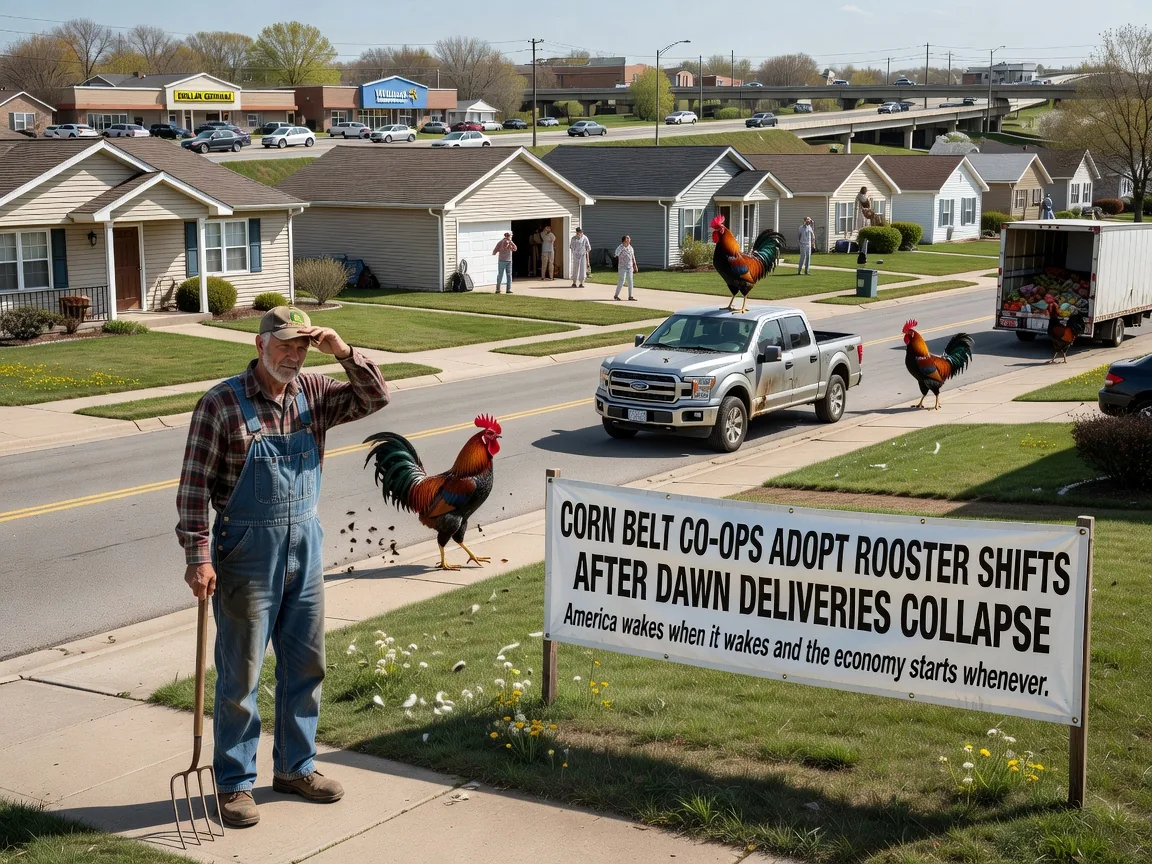
Corn Belt Co-ops Adopt Rooster Shifts After Dawn Deliveries Collapse

Elevator operators log 47 percent of grain trucks arriving post-noon

Corn Belt Co-ops Adopt Rooster Shifts After Dawn Deliveries Collapse

Illinois co-op managers have posted printed rooster crow schedules at every scale house, replacing the previous 6 a.m. assumption. Drivers who arrive before the first documented crow are turned away and assessed overnight storage fees based on solar noon.

The change has increased average delivery windows to four hours and twenty minutes, with one coop in McLean County reporting that three silos remain half-full because haulers refuse to start engines until the birds confirm local mean time.

Crime

Daylight Burglaries Rise as Homeowners Skip Morning Alarm Routines

Suburban precincts cite 28 percent drop in occupied-house deterrents

Daylight Burglaries Rise as Homeowners Skip Morning Alarm Routines

Police logs from Fairfax County show residential break-ins now cluster between 9:15 and 11:40 a.m., the hours previously protected by commuter departures. Detectives note that without synchronized wake times, neighbors no longer provide mutual surveillance during the former rush period.

One suspect told officers he simply waited until three consecutive driveways remained empty past ten o'clock before entering; prosecutors have requested that courts adopt water-clock timestamps to establish precise time-of-offense records.

Op-Ed

Loading...
By Guest Contributor
Loading...
Comic Strip
Page 1 of 2

Today's Episode — 60 Seconds From a Parallel America

Every episode on YouTube →